

CHAPTER THREE
Racism in the Ranks
Book One: Setting the Stage by K.A. Gilmore
My Dad
My dad was military police (MP) and was responsible for enforcing military justice. He spent 20 years in those tough conditions in both the Korean and Vietnam wars which perhaps explains some of his at-home unrest. My childhood, my core memories, and my formative years occurred during my dad’s military service, as I was ten when he retired. I have no memory of any military fanfare until his death. He was finally celebrated with full military honors befit a king with taps and all in 2001.
As a result, a friend, lent me her dad, who’s career in the Air Force started as my dad was retiring. You will see Retired Master Sergeant, Oliver P. Nowlin’s name frequently in Book One and Book Two. He filled in the gaps. The inside view of the military that I could not capture from my dad, due to his passing.
Thank you April’s Dad!
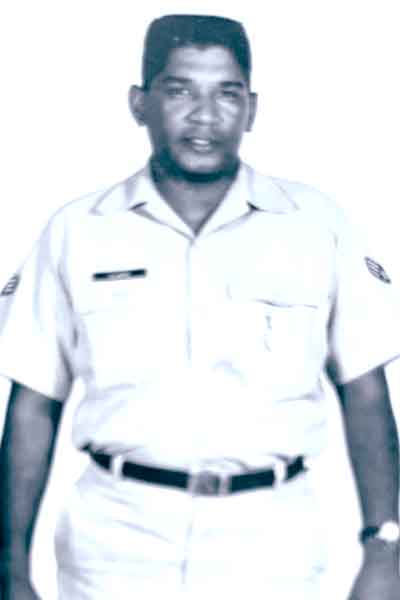
Staff Sergeant Alfred Gilmore

Master Sergeant Oliver P. Nowlin.
The Nowlin family has been serving this country with 100 relatives in the national cemetery. Oliver entered the military in 1977, and said it was “almost four years” before he saw a black Master Sergeant. And another four, before he saw a Senior Master Sergeant. This is post WAPs, during what he describes as “an opportune time” because the military needed recruits.
Below the Zone
Master Sergeant (Ret.) Nowlin competed for promotion to Senior Master Sergeant and earned a 415 out of 420 on Weighted Airman Promotion System (WAPS), a score reflecting near perfect performance across testing, evaluations, time in service, and decorations. Despite an exemplary service record and a long family history of military service, Nowlin was not selected for promotion. His case illustrates how advancement to E8 is shaped less by individual merit alone than by constrained promotion quotas, senior rater discretion, and access to limited specialty and leadership pipelines (U.S. Department of the Air Force, AFI 36 2502).
The consequence was not merely symbolic. Because enlisted members must serve at least two years at their highest grade for that rank to be used in retirement pay calculations, the missed promotion fixed his retirement pay at the E7 level rather than E8, resulting in an estimated five hundred thousand dollars or more in lost lifetime compensation, including reduced monthly retired pay and survivor benefits (Title 10 U.S. Code § 1406; Department of Defense Financial Management Regulation).
This case demonstrates how a promotion system that appears race-neutral and performance-based can still produce outcomes where exceptional achievement fails to overcome structural bottlenecks, producing permanent and measurable financial consequences long after active service ends.
Read full excerpt, Below the Zone, to get more details on a system that intended to fix discrimination still failed mightily.